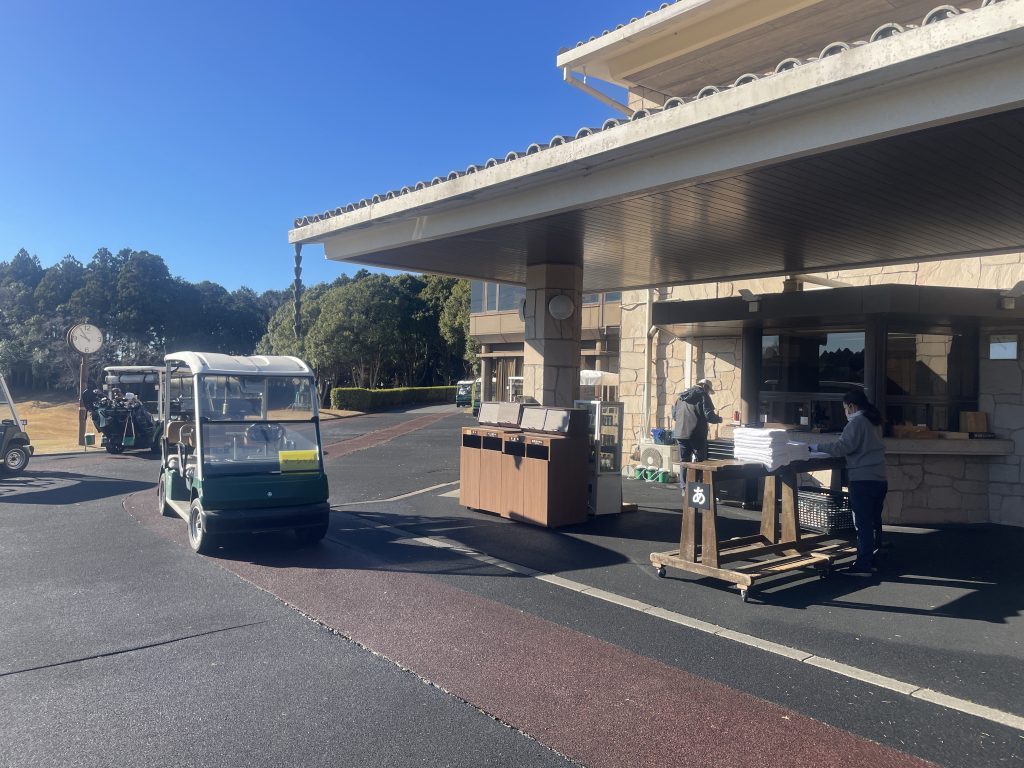
Many Japanese golf carts look similar at first glance, but their controls can be very different. A five-seat cart may follow a fixed route automatically, respond to a hand-held remote, or be driven by a player. Before moving it, establish which system the course uses.
Three common cart systems
A rail-guided automatic cart follows a set path and does not need steering. A player starts and stops it using a button on the cart. On some systems, one person also carries a remote control so the cart can move while players walk to their balls.
Player-driven carts have steering, accelerator and brake controls. They must follow course signs, one-way routes and speed limits. Japan drives on the left on public roads, but internal course directions and safety signs are the immediate authority.
Remote control should be assigned to one person. Check that everyone is seated or standing clear before pressing start, and never move the cart from a position where you cannot see it.
On an automatic cart, the vehicle can stop at a series of programmed points. Pressing the button again may send it further than a new user expects. Learn the stop control before the first hole and keep the remote away from loose objects in a pocket. If the cart does not respond normally, contact staff rather than trying to push or bypass the system.
What the GPS display does
Cart GPS systems can show the hole map, distance to the front, centre or pin area, and the location of the group ahead. Some include digital scoring, group rankings and messages from course staff. Distances may be displayed in yards, so check the unit before selecting a club.
The group-ahead display is a safety and pace tool, not permission to hit whenever the screen changes. Maintain visual judgement. Pace warnings may appear when your group falls behind; respond by preparing earlier and moving efficiently, not by speeding around bends.
Pin information on the GPS can be updated for the day, but it is still an aid. Check whether the distance is to the front, centre or current pin position. A laser rangefinder may be allowed, yet competition or local conditions can differ. The course’s instructions take priority over a device.
Enter scores after moving clear of the green so the following group is not held up. Course messages about weather, evacuation or a change in operation take priority over normal play.
Cart paths and fairway access
A cart being included does not mean it may enter the fairway. Many courses are cart-path-only as their normal rule. Fairway entry may be offered only for designated carts, holes or booking plans and only when turf and weather conditions permit.
Rain, frost, maintenance or ground softness can lead a course to cancel fairway access on the day. Even where access was advertised, the course may need to protect the turf. Without a clear sign, flag or staff instruction granting permission, remain on the path.
Permission never includes greens, tees, bunkers or marked no-entry areas. Follow directional signs and keep an appropriate distance from sensitive ground.
Where fairway entry is allowed, use the permitted entry and exit points rather than repeatedly crossing ropes or kerbs. Avoid sharp turns and sudden acceleration on grass. A permission flag identifies the service; it does not remove the driver’s responsibility to protect the turf.
Permission, flags and charges
Some courses identify approved fairway-access carts with a flag or other marker. An additional charge may apply per person, per cart or under a specific plan. There is no universal Japanese fairway-access fee, and not every course offers the service.
Check the booking terms and confirm again at the start desk. If access is cancelled for turf conditions, the treatment of any booked charge depends on the course’s policy.
Safety and licence restrictions
All passengers should use proper seats and keep hands, feet and clubs inside while the cart moves. Slow down on slopes, wet surfaces and sharp turns. Make sure golf bags are secured and the rain cover cannot catch loose clubs.
A player-driven cart may carry age, driving-licence or sobriety restrictions. Follow the course’s rule rather than assuming an overseas licence automatically permits operation. Do not drive after drinking alcohol, and do not read the GPS while the cart is moving.
Some courses restrict operation to a person who has presented an acceptable licence or completed an explanation. Others use only automated carts and do not permit player steering at all. Confirm this before assigning group roles, particularly when the booking includes older guests or players who prefer not to drive.
Stop immediately when staff, alarms or on-screen messages require it. Time lost to a weather pause should never be recovered through unsafe driving.
Practical group arrangements
Place someone comfortable with the controls in each group instead of putting every experienced player in the first group. Explain the start, stop and emergency controls before the first tee. Hire clubs must be loaded onto the correct cart and checked by name.
When your ball is across the path, take two or three likely clubs rather than moving the whole cart back and forth. This improves pace while respecting cart-path restrictions.
Cart operation fits into the wider sequence of what to expect on a day of golf in Japan. The dependable rule is to identify the system, appoint one operator and treat fairway entry as course-specific permission, not an entitlement.
When uncertain, stop in a safe place and ask the start desk or course staff. A brief explanation before moving is better than correcting a damaged route, an unsafe stop or a turf violation later.