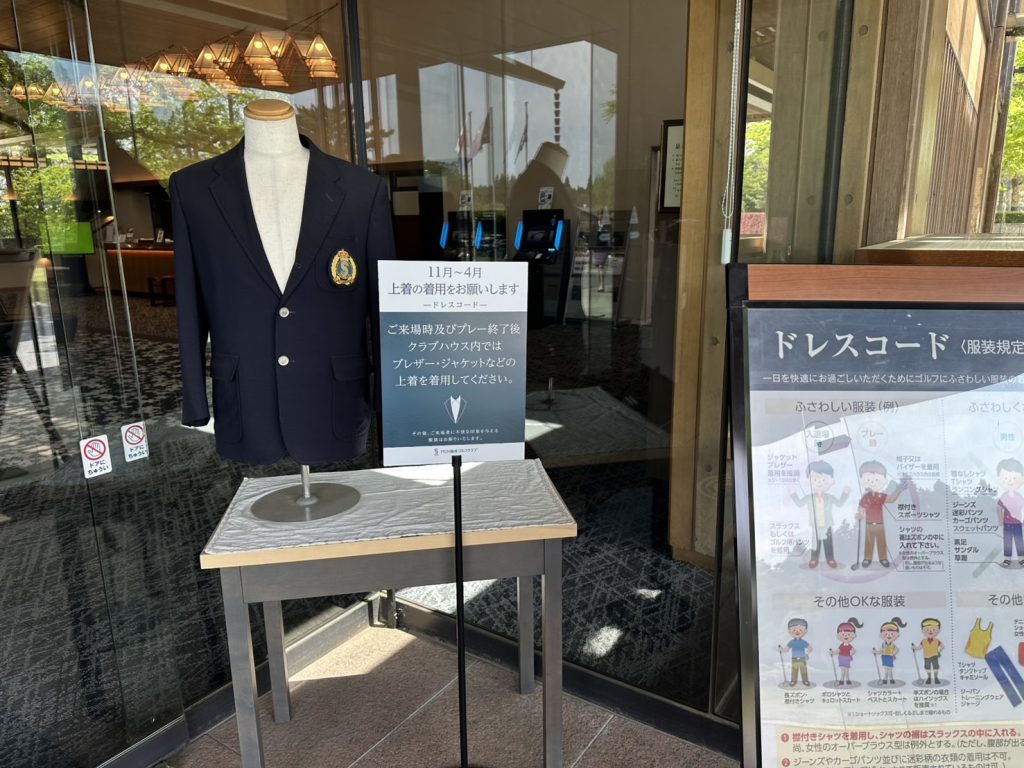
Do you need a blazer to play golf in Japan? Sometimes—but not at every course. Formal member clubs, resort courses and public courses can take noticeably different approaches. The safest preparation is to read the current official dress code for the course you have actually booked.
There is no single national dress code
Some established member clubs maintain detailed rules for arrival, departure and play. Other visitor-oriented or public courses use a practical golf-wear standard, and a few explicitly describe their policy as casual. Even courses managed by the same operator may set their own conditions.
A social-media photograph is not reliable evidence of the current rule. It may show a summer exception, a private event or clothing that was tolerated rather than approved. Use the course website and booking notes, and ask the booking contact when wording is unclear.
Arriving at the clubhouse
At a formal club, men may be asked to wear a jacket or blazer over a collared shirt when entering and leaving the clubhouse. Denim, tracksuits, sandals, flip-flops and clothing designed mainly for the beach or gym are commonly discouraged. Some clubs relax the jacket rule during designated summer months.
Carry a lightweight jacket in your clothing bag when the club requires one. Do not pack it at the bottom of the golf bag, which may already have been transferred to the cart area. Hats should normally be removed inside dining and reception areas unless the course says otherwise.
Use the changing room rather than travelling in muddy golf shoes or wet outerwear. At the end of the round, clean shoes at the provided air station and change before re-entering formal clubhouse areas.
Arrival clothing does not need to be expensive. A simple, well-kept jacket, collared shirt and tailored trousers can meet a formal policy more reliably than conspicuous fashion. Avoid large slogans or garments intended primarily for another sport when the club asks for restrained clubhouse wear.
Clothing during play
A collared golf shirt, tailored golf trousers or suitable golf shorts, and proper golf shoes are a dependable starting point. Some clubs accept mock-neck golf shirts while others specify a conventional collar. Rules on whether a shirt must be tucked in also vary.
Soft-spike or spikeless golf shoes are normally appropriate. Street shoes, hiking footwear and metal spikes should not be assumed acceptable. If hiring shoes, reserve the correct size in advance because overseas sizes may not be available in sufficient numbers for a group.
Shorts are widely used, especially in summer, but sock rules are course-specific. One club may accept ankle socks while another asks for longer socks. A cap or visor is sensible for sun protection and may be expected during play, but remove it where the clubhouse requests this.
Do not hang a towel from the waist or carry it around the clubhouse unless the course permits this. Keep towels in the cart basket or designated area. The same applies to rain covers and wet gloves: organise them before entering dining and reception spaces.
Summer and winter
Japanese summers are hot and humid. Choose breathable golf clothing, carry a spare dry shirt and use sun protection, while still observing the course’s collar and shorts rules. Cooling sleeves or other technical garments should look suitable for golf and comply with any published restrictions.
In winter, layered clothing is more useful than one bulky coat. Thermal base layers, a golf sweater, wind-resistant outer layer and warm hat can be practical, but movement and safety still matter. Rainwear belongs in the clothing bag so it remains accessible if the forecast changes.
Morning frost and strong wind can make a course feel colder than the nearby city. Bring enough layers to adjust between the exposed course and the heated clubhouse. If temporary winter greens or a delayed start affects the round, the clothing rule itself does not change unless staff announce an exception.
Women’s clothing
Women should follow the same distinction between clubhouse arrival wear and clothing for play. Golf dresses, skirts, tailored shorts and trousers may be acceptable, subject to the individual club’s guidance on length and fit. Very short garments, beachwear, denim and open footwear are more likely to conflict with formal policies.
Some websites describe men’s rules in greater detail than women’s. That does not mean no standard applies. When planning for a group, send the course’s current guidance to every player rather than giving only a men’s blazer instruction.
Leggings, sleeveless tops and golf dresses are treated differently from course to course. Where the official wording is unclear, ask about the exact garment rather than relying on a broad question such as “Is casual wear acceptable?” This produces an answer the traveller can actually use.
A reliable pre-trip check
Confirm four points: whether a jacket is required on arrival, accepted shirt styles, the shorts-and-socks rule, and permitted golf shoes. Note any seasonal exception and share the official page or a current written confirmation with the group.
The dress code is one part of what to expect on a day of golf in Japan. Miramar uses the booked course’s current rule rather than treating custom as a fixed national law. The aim is not to make visitors anxious; it is to arrive prepared and avoid a preventable delay at registration.
If the group plays several courses, make a separate note for each one. The most formal requirement should not automatically be described as the rule everywhere, but packing to meet it can simplify a multi-course itinerary.