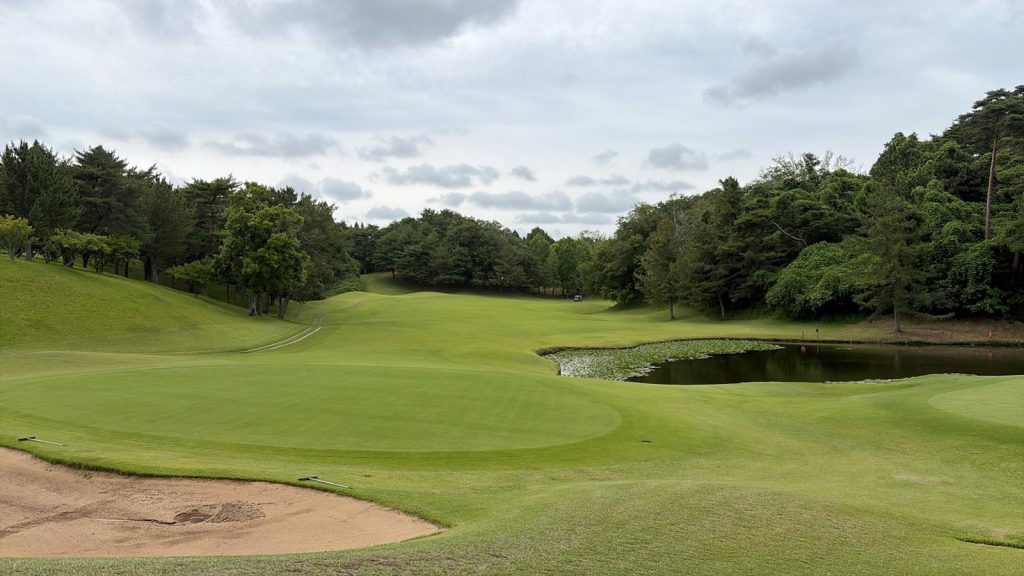
Good etiquette in Japan is not about pretending that every local golfer is perfect or treating overseas visitors as a problem. It is the shared work of keeping the round safe, moving and fair for the next group. On self-play courses, each player has more responsibility for pace and course care.
Keep pace without crowding
Japanese courses can use relatively tight tee-time intervals. Keep a practical distance behind the group ahead and aim to retain your place in the field. At the same time, never hit while people ahead are within range. GPS position information is useful, but visual judgement remains essential.
Do not drive close behind the group ahead or stand where your movement distracts them. Keeping pace means reducing avoidable delay, not applying pressure to players who are still making a safe shot.
If the cart GPS shows a pace warning, check where time is being lost. Prepare earlier, move promptly between shots and record scores after clearing the green. Follow a marshal or staff member’s instruction if the gap needs to be recovered.
Tee intervals being tight does not justify hitting into the group ahead. If your group is waiting on most shots, remain patient and visible at a safe distance. The course, not the following group, decides whether intervention is required.
Prepare before your turn
As you approach the ball, assess the distance and take two or three possible clubs when appropriate. Complete most of your preparation before it is your turn, without moving or talking during another player’s stroke.
Ready golf can help in stroke play when it is safe and the group understands who will play. It does not override safety or allow someone to distract a player who is already addressing the ball.
After a hole, move the cart or walk clear before entering scores. Park on the exit side of the green when possible so the group does not need to return towards the fairway.
Players do not need to follow strict “farthest away first” order in every casual stroke-play situation when ready golf is appropriate, but the group should communicate quietly. A clear “you go ahead” prevents two players from beginning at once.
Lost balls and provisional balls
Under the current Rules of Golf, the search time is generally three minutes. Everyone can help look, but begin timing realistically and be ready to continue when the time expires.
When a ball may be lost outside a penalty area or out of bounds, play a provisional ball when the rules allow and announce it clearly. This avoids a long return to the previous position. Course-specific local rules or forward-drop areas should be followed where provided.
Carrying spare balls and a second likely club reduces trips back to the cart. A high score does not automatically cause slow play; waiting until each turn to make every decision does.
Bunkers, pitch marks and divots
Enter a bunker from a safe, low side that causes the least damage. After the shot, rake footprints, the stroke area and marks made while collecting the rake. Leave the surface reasonably level for the next player and place the rake where the course instructs.
Repair a pitch mark on the green as soon as practical. Work gently from the outside towards the centre and press the surface level with the putter. Do not lever the centre upwards, which can damage roots.
Replace divots or fill them with the sand mixture provided, according to the course’s practice. Some carts carry sand bottles. Use them for the intended divot area rather than scattering sand broadly.
On some Japanese fairways the bottle contains a sand-and-seed or sand-only mixture selected by the course. Fill the scar level rather than building a mound. If no bottle is supplied and the divot cannot be replaced cleanly, leave it for staff rather than taking material from another area.
On and around the green
Be aware of other players’ putting lines, avoid dragging your shoes and keep bags off the putting surface. Put the flagstick down gently if it is removed. Stay quiet and still while another player prepares to putt.
When everyone has holed out, replace the flagstick and leave promptly. Discuss scores and settle small questions at the next tee, not while the group behind waits to play into the green.
Quiet behaviour and staff instructions
Put phones on silent near tees and greens. If a call is necessary, move away from players and keep it brief. Call “Fore” immediately when a ball may travel towards another person.
Course staff may direct groups to speed up, pause, move to shelter, use a local rule or keep carts on paths. Follow the instruction even when it differs from a previous visit. Weather, turf and field conditions change.
Before bringing a group to the course, share three expectations: stay with the group ahead without crowding it, repair the ground you affect, and ask staff when unsure. The broader arrival and departure routine is covered in what to expect on a day of golf in Japan. Good etiquette is quiet confidence: safe decisions, efficient preparation and leaving the course as you would want to find it.
A group leader can place an experienced player in each fourball and explain local rules before the first tee. This is more useful than correcting every detail during play, when conversation itself can become another source of delay.
The standard applies equally to residents and visitors: protect people, protect the course and help the field move at a reasonable pace.